WorkCyberwiz
[CS 02]
How Cyberwiz turns vendor security reviews into a repeatable workflow
A conversation with
 Baruch MenahemCTO @ Bindsec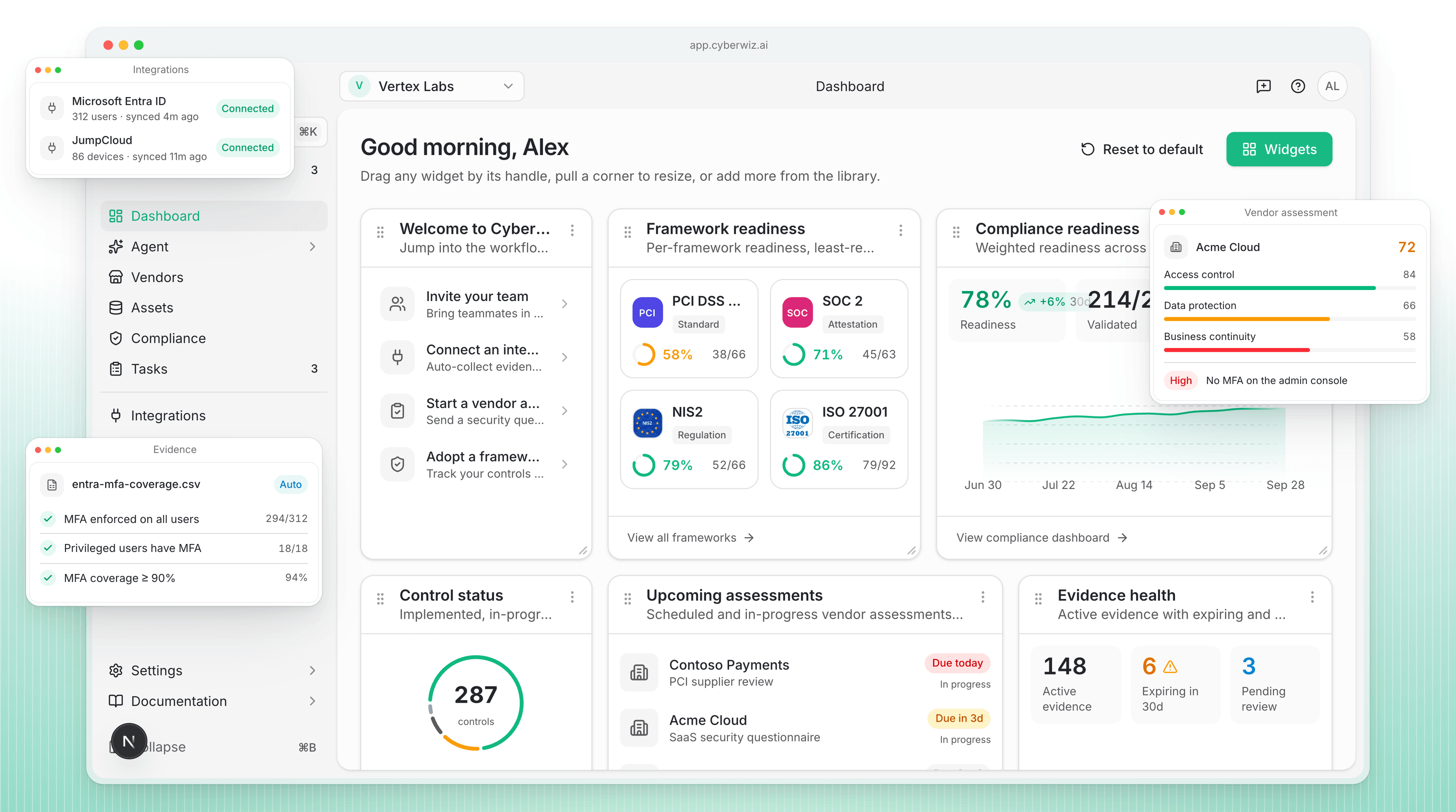
Challenge
Third-party security review is a spreadsheet problem at most organizations. Questionnaires go out by email, evidence arrives as loose attachments, findings are written up by hand, and nothing carries forward, so every reassessment starts from zero and no one can show a defensible trail.
Solution
A platform that runs the whole review as one workflow: structured questionnaires, evidence pulled automatically from vendor environments, findings scored and mapped to frameworks, and a live watchlist that tracks risk between assessments.
Results
- Vendor assessment shipped as a complete workflow: intake, questionnaire, evidence, scoring, report, reassessment.
- Evidence collection automated against vendor environments, so maturity is backed by artifacts rather than self-reporting.
- Findings map to frameworks including SOC 2, ISO 27001, PCI DSS, and NIS2 with per-framework readiness tracked.
- Built to scale from a handful of vendors to hundreds without adding operational burden.
Cyberwiz.ai is an intelligent security management platform, shipping first as vendor security management. Gridline owned architecture, design, and build, from discovery and flows through to a scalable app for security teams and CISOs.
Assessment that produces evidence, not assertions
A questionnaire answer is a claim. On its own it tells you what a vendor believes about themselves, which is a weak foundation for a risk decision.
Assessments are structured item by item: each control answered No, Partial, or Yes, with evidence attached against the specific question it supports. Script checks then pull signals directly from vendor environments, so the maturity score has artifacts behind it: TLS chains, policy acknowledgements, posture scans, each captured and sealed as part of the run.
“Gridline developed Cyberwiz.ai in close collaboration with us. They understood our vision and translated complex ideas into a robust, scalable product — a true partner, not a vendor.”
Baruch MenahemCTO @ BindsecFindings a security team can act on
A risk score with nothing underneath it is not actionable. Every finding is written as a full record: impact and likelihood, the desired state, the specific gap, the risk it creates, and concrete mitigation strategies, linked back to the question that surfaced it and the evidence the vendor supplied.
Vendors get a right of reply on the record itself, so context like an in-flight migration sits beside the finding rather than getting lost in an email thread.
- Severity derived from impact and likelihood, not assigned by hand
- Every finding traceable to its question and its evidence
- Remediation tracked to closure rather than filed away
Posture that stays current between reviews
A point-in-time assessment is stale the week after it lands. The platform treats vendor risk as a rolling program: periodic reassessments on a cadence, a live watchlist of suppliers under active review, and risk tracked over time rather than recomputed from scratch.
The dashboard is built around that ongoing view: framework readiness per standard, weighted compliance across adopted frameworks, control status, upcoming assessments, and evidence health, with expiring artifacts surfaced before they lapse. Widgets are arranged by the team that uses them.
- Security teams: consistent, auditable reviews in one place
- Procurement and vendor management: due diligence alongside contracting
- GRC and compliance: vendor controls mapped to obligations
- Regulated industries: repeatable workflows under scrutiny
Ship your next product with one team
One partner for design and build. Clear direction, no handoffs, from concept to launch.
Get in touch